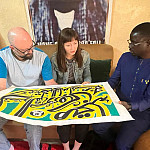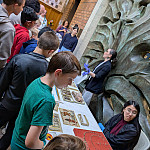
Beloit Heritage Days at the Logan Museum
Beloit College Curator Nikita Werner and museum studies students took community members back in time through the Paleolithic (Stone Age) collections.
more

Museum studies explores how museums collect, interpret, preserve, and present objects, stories, and knowledge. The field examines museums as educational institutions and cultural actors, asking how exhibitions shape public understanding of history, art, science, and identity. Students study the intellectual, ethical, and practical foundations of museum work while learning how objects and collections are used to communicate meaning.
Museums sit at the intersection of culture, education, research, and public engagement. Museum studies helps you understand how institutions make choices about what to collect, how to interpret objects, and how to serve diverse audiences responsibly. You develop skills in research, visual analysis, writing, collaboration, and ethical decision-making that are valuable in museums and far beyond.
This minor is well-suited for students interested in history, anthropology, art, education, public humanities, science communication, and cultural stewardship, as well as those considering graduate study or careers in museums, archives, and cultural institutions.
Beloit College is a national leader in undergraduate museum studies, with more than four decades of experience in the field. Beloit College is set apart by the integration of coursework with sustained, hands-on practice in two on-campus teaching museums: the Logan Museum of Anthropology and the Wright Museum of Art. These are active museums where students work directly with collections, exhibitions, research, and public programs.
Museum studies students learn alongside museum professionals who teach the core courses of the minor. You gain practical experience through collections care, exhibition development, public interpretation, and internships, on campus and at partner institutions. Students work with additional campus collections, including the Beloit College Archives, the Historic Costume Collection, and scientific collections, building a broad and adaptable skill set grounded in real-world museum work. Students may also participate in Beloit College’s Center for Collections Care, a summer program where museum professionals develop skills in aspects of collections management and conservation.
Students interested in museum studies may consider majoring or minoring in related fields such as anthropology, history, art history, studio art, media studies, or visual studies to deepen expertise alongside applied museum training.
Museum studies combines interdisciplinary coursework with sustained experiential learning in museums and collections, emphasizing ethical practice, object-based research, public interpretation, and professional preparation.
Completing the museum studies minor from Beloit College prepares students to think critically about museums, collections, and public knowledge while gaining practical experience that translates directly to professional and civic settings.
Share a few quick details, and we will connect you with your admissions counselor and information that fits your interests.
Request Information about Beloit College
The best way to get to know Beloit College is to be here. Take a tour of campus, talk with students, and see Beloit for yourself.
Visit the Beloit College Campus
Found what you have been looking for? Apply today and begin your path toward an undergraduate degree from Beloit College.
Apply to Beloit College
This site uses cookies to improve your experience. Read our Web Privacy Policy for more information.
Got it! ×