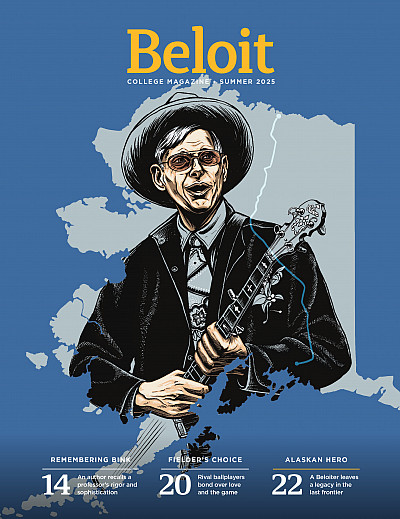
Richard Fineberg: An Alaskan Hero
An investigative journalist, public servant, and folk musician who made an outsized difference is remembered with great fondness and respect by many in the last frontier.
It was the mid-1980s, and Deborah Niedermeyer rang Richard Fineberg ’64 in his cabin outside of Fairbanks, Alaska. Someone answered the phone, but it was not him.
At that time, it was common to live without running water and off the phone grid, “and no one locked their doors,” says Niedermeyer, “so if you wanted to see someone, you would usually just show up, and if they weren’t home you would leave a note on their kitchen table.”
Fineberg’s cabin was a roughly 600-square-foot structure with no running water, and like many such cabins, was just one room with a sleeping loft up along the back wall, small woodblock counter and sink with slopbucket underneath, woodstove, row of mugs on pegs. On a shelf, a few pots, cast-iron pan, plates, bowls, and silverware. A rug, an armchair or two, a set of boots by the door. And in his case: a banjo in the corner, piles of papers all over the room, and a telephone.
The voice on the other end of the line belonged to Steve Cowper, who was at that moment about four months away from being elected Alaska’s governor. “I’m sitting here drinking Fineberg’s whiskey,” he told Niedermeyer. “If he’s not back in fifteen minutes I’m leaving.”
Richard Fineberg, who passed away Sept. 27, 2024 at the age of 83, is remembered for an unconventional and consequential life and legacy. From his rustic cabin ten miles outside of Fairbanks, over the course of his more than four decade career as an investigative journalist covering the Alaskan oil industry — and as a petroleum industry policy advisor to two state administrations during the high volume, high stakes 1980s — Fineberg had the ear of those in power, and through sheer perseverance, fierce intelligence, and an unwillingness to compromise, held to account some of the most powerful corporate interests in the world and across all time, and the government that too often failed to adequately regulate them.
Watchdog for the environment and the public interest

Credit: Courtesy of Laura FinebergFineberg first came to Alaska in 1969 at the leading edge of a wave of young people searching for a life on the land, free of convention. He began his professional life as a political science professor at the University of Alaska Fairbanks, but left that position within a few years to pursue investigative journalism. Oil had been discovered on the North Slope and his attention was drawn to the developing plans for a pipeline along an 800-mile route across three mountain ranges to the Port of Valdez on Prince William Sound. Fineberg’s public interest reporting during construction of the pipeline — 100 articles alone from 1974 to 1977 — raised issues both environmental and economic, serving as the basis for investigations by the Alaskan Pipeline Commission and more broadly for public understanding of the project’s risks.
“He was a tireless scholar whose idea of a good time was to immerse himself for weeks or months in a complicated investigation of oil industry or government chicanery,” fellow Alaskan journalist Dermot Cole recalled in a post on his blog, Reporting from Alaska. Fineberg’s work probed the pipeline’s operation and maintenance, financial agreements between the oil industry and the state, the regulatory framework for protecting the public interest, and the politics that swirled around all of these questions, many of which are still relevant today.
By the early 1980s, Fineberg had so fully demonstrated his depth of understanding of the industry and his ability to identify regulatory failures and industry maneuverings that he had the ear of those at the highest levels of state government. He was brought in as a petroleum industry analyst in the governor’s office, serving under both the Sheffield and Cowper administrations from 1983 to 1989. He ultimately left that position over a policy disagreement, and returned to freelance research and journalism, continuing well into the 2010s.
Through his reporting and policy analysis, Fineberg brought to public consciousness several major stories, including his discovery that a 1985 tariff settlement significantly undermined how much the state could charge oil companies for the privilege of transporting oil through the pipeline, an error not rectified until 2002. “If Alaska had properly regulated tariffs between 1977 and 2002,” historian and University of Alaska Fairbanks Professor Philip Wight wrote in the Anchorage Daily News in October 2024, “Alaska would have collected an additional $10 billion.” Fineberg also discovered lapses in industry commitments to fund end-of-life pipeline decommissioning and environmental restoration: funds meant to be deposited into an escrowed trust fund were instead held internally, earning tens of billions of dollars for the companies and holding open the possibility for them to later choose to delay or even avoid ever paying those substantial costs.
Arctic environmental researcher Richard Steiner recalls, “At oil industry conferences, he was always a somewhat enigmatic presence, lurking quietly along the edges, osmosing and processing information being presented, finding the holes in industry arguments, and meticulously boiling it all down to the most important conclusions for the environment and the rest of us. His presence really worried the bad guys!”
Meticulous investigative journalist
From our age of the internet, it is hard to fathom the creativity, tenacity, resourcefulness, and meticulousness necessary for Fineberg, from his cabin far from the state capitol in Juneau, to gain access to, synthesize, understand, and report to the world the machinations of some of the most powerful multinational corporations in the world. But he did just that.
“He drove people crazy because he was so meticulous. I was one of the ones who Fineberg made the least crazy, and he made me crazy,” shares his longtime friend Deborah Niedermeyer. “But that was how he found out stuff. And I loved him for it.” Niedermeyer supported Fineberg in producing the Interior Alaska Newsletter, an alternative publication he developed to get his research into the public’s hands when the established press would not publish it. After the first issue was printed, they found a typo on page three. Rather than allow it to be distributed with an error, Fineberg used bottles of correction fluid to fix each copy by hand before it was sent out to the initial circulation of about 250 subscribers.
Fineberg’s zealousness for accuracy and thoroughness was at the core of his credibility. Fellow journalist and author Dan O’Neill recalls a panel they participated in at the University of Alaska Fairbanks, without being warned that a provocateur had been invited to join them. O’Neill found himself “mush-mouthed” when confronted by a barrage of attacks on Fineberg and his research. “Not so Richard. He had arrived with two big piles of documents — drafts and publications, each nearly a foot high — which he had set on the table in front of him. He extended his long arms and pushed both piles in front of the speaker, who sat beside him. ‘Here,’ he said. ‘This is my recently published work with notes and sources. Now, please find for me any statement I wrote that is inaccurate.’ Getting silence for a reply, Richard pushed the pile even closer to the man and continued, ‘It’s a lot of material, so let me help you. You tell me what I wrote, and I’ll find it for you.’ He cut the guy off at the knees.”
Early indications
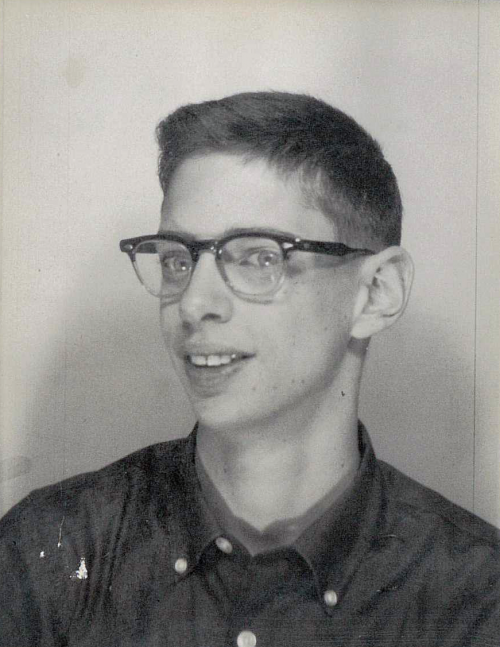
Credit: Beloit College ArchivesJohn Barber ’60 was editor-in-chief of The Round Table when Fineberg arrived at Beloit College as a freshman in 1959. Barber remembers this as a time when most students were joining fraternities and planning for conventional lives in business, with just a few “independent” students — himself and Fineberg included — who “had different ideas, and were searching in different ways.”
Later, when he learned of Fineberg’s work in Alaska, Barber was unsurprised. “Fineberg seemed to be a self-directed person with real commitment. I could see him finding his niche in something of great import.” Fineberg visited him in Seattle years later. “I had a feeling he was doing something important, but precarious for him because he had to get things exactly right,” Barber recalls. “It was really tough investigative work — through public records, hours and hours, again and again, to discover and verify … Someone had challenged him on some of his reporting, and he was anxious about that, worried about not getting things right. He was very conscientious.”
In Fineberg’s application essay to Beloit College, he described his experience as editor of his high school newspaper as “the most important part in my development,” noting that he came into the editorship in the first year that the paper was completely student run, “which means that I take the ultimate responsibility for everything we print.” Fineberg later became editor of The Round Table.
In a graduate school recommendation letter, Professor of Political Science Harry Davis acknowledged that Fineberg “had one very poor semester of coursework on account of devoting too much of himself to the editorship of our student newspaper,” going on to praise his “unusual strength of personal and intellectual integrity,” and adding, “He thinks and writes with great clarity and persuasive power. I believe he will ultimately become an excellent teacher or serious journalist.”
An unconventional life
After graduation from Beloit, Fineberg pursued graduate work in Asian Studies, living for some time in Taiwan, before completing his PhD at Claremont Graduate School in California, where he fixed his attention and his dissertation on the exploitation of Mexican farmworkers in the grape industry. After his move to Alaska — in a Forest Gump-like moment amidst a life of adventure — Fineberg joined the crew of the fishing boat that set out to stop a nuclear weapons test in the Aleutian Islands, an act of resistance that launched the Greenpeace movement.

Credit: Robert Keziere, Courtesy of Greenpeace
Despite his seemingly overwhelming attention to his work, Fineberg lived a rich and full life. His peers, and daughter Renata, describe his statewide network of friends, his lifelong fascination with trains and train hopping, his treks into the Alaskan wilderness, engagement in local politics, and lots of music.
The musician Robin Dale Ford arrived in Fairbanks around the same time as Fineberg, their friendship dating back to 1973 within a broader community of musicians and cabin dwellers. Fineberg played banjo and was a bluegrass aficionado. “With Richard, you could get into total minutiae over everything, even with bluegrass: he would know how a particular artist played a certain lick in a song. He was an expert on the east coast bluegrass scene of the 1960s.” Fineberg and Ford played with friends around campfires and also performed together at folk festivals around the state.

Credit: Courtesy of Robin Dale Ford
Fineberg was also infamous for hopping freight trains. He once made his way thus, roundtrip Seattle to New York City, to collect a national journalism award of $5,000, the check in his shoe for safekeeping on the return trip. Another friend, on a remembrance page, tells the story of Fineberg arriving in Denver for a visit by freight train in the early 1990s, when he would have been about 50 years old. He jumped from the train, banjo in one hand, and broke his other arm while trying to avoid railyard officials.
In a less romantic but community-minded move, he briefly ran a garbage collection business in Fairbanks, until his truck combusted on the road, likely because of hot ash discarded from someone’s wood stove. “I know Richard as a pretty fun-loving, silly person, and also as a really sweet, caring person,” says Ford. “Those are values at the core that he wasn’t going to shake. He was just a wonderful being.”
An uncompromising path

He departed government service after several years, unwilling to compromise on a policy question. “Richard was incredibly independent, and a real critical thinker,” says Wight. “He would buck trends, and he frequently made people upset because he was so principled and courageous. Some people might say it made him harder to work with. Others would say he was a pain in the ass.” This may be the most instructive thread to pull from Fineberg’s life: someone has to be the one making everyone else crazy, and working from the outside can be effective in ways working inside the system cannot.
So Fineberg operated from both inside and outside, and kept those distinctions clear. Though he had a PhD, he refused throughout his career to use the honorific, preferring that his work be credited based solely on its merits. While in state government, Fineberg was often required to wear a tie, and his garish collection was infamous. “It was a protest,” says Deborah Niedermeyer. “He was saying ‘If I have to wear a tie, it’s going to be a crazy one.’” He lived an ascetic life in a cabin without running water, with wood heat, for almost his entire adult life, which gave him the economic freedom to do his work as he saw fit. “He was still, into his 70s, out shoveling that long driveway of his,” says Niedermeyer.
A lasting legacy
Alaska is deeply dependent on oil revenues, and as production declines economic pressures are increasing, with plans for a new natural gas pipeline and a slate of open pit mining proposals popping up across the state. Many of his friends note these concerning developments. “Like Richard, I love Alaska,” says Robin Dale Ford, who is currently involved in local and state-wide efforts to educate the public about largely foreign-backed corporate metal mining. “It’s hard to dedicate your life, but once you know … they want us to go away, but we’re going to keep on just like Richard did. Though no one,” she adds, “is putting it together like he was.”
A vast store of Fineberg’s papers has been donated by his daughter to the University of Alaska Fairbanks. “It’s a gold mine” says Wight, who sees in it the potential for many historical studies, “but it’s also bewildering, there’s a lot of paper. It’s going to be a major effort just to get the papers organized and ready to be archived. Richard would want the files used to defend the public interest, and to defend those issues that he cared about. The files need to be accessible so people can use them.”
At some point in the 2000s, Fineberg launched a website, now accessible only through a web archive, where he was sharing and archiving his reporting. On the home page, last updated in 2012, he writes:
During the 4½ decades since the discovery of the nation’s largest oil field at Prudhoe Bay on Alaska’s North Slope, events from Watergate to the collapse of energy companies such as Enron and, subsequently, financial institutions in the recent financial crash demonstrate that large institutions frequently fail — often by grotesque margins — to live up to legal and moral obligations and to deliver on their public pronouncements.
Concurrently, the major Alaska oil companies that play a predominant role in Alaska development have displayed a chronic and troubling discrepancy between promise and practice. Despite lavishly funded advertising campaigns and public relations efforts urging that Alaska’s oil companies can be trusted as the avatars of social salvation, closer examination reveals a profound gap between what these companies say and what they do.
With equally disturbing regularity, when confronted with evidence of those failures, the government has failed to protect the public interest … Reports on pipeline and petroleum development issues on this website may be understood as case studies providing insight into the relationships among powerful corporate and government institutions.
This web site explores the economic and environmental impacts of these interactions in concrete terms in the hope that well-informed individuals can and will make a positive contribution to the course of human development. A premise underlying this research is that it falls to each of us, as citizens, to keep our policy dialogue fact-based as we inform ourselves, analyze, and respond appropriately to the events that shape the issues we face.

Credit: Courtesy of Olaf DietzFineberg traveled to the North Slope at least once, four hundred miles from Fairbanks. The haul road was closed to the public, only for oil industry travel, so he would have had to talk a trucker into letting him catch a ride. He traveled with his banjo as a roving musician, which he was, and also as a journalist undercover as a roving musician, which he also was, collecting stories from people on the ground who knew what was going on with the pipeline. He did his work with all seriousness, willing to sacrifice for it, unbounded by convention, still having fun along the way.
Fineberg teaches us to be informed, to pay close and relentless attention, and to truly, actively care for that which matters to us. What mattered to Richard Fineberg was everpresent in his life and work.
“His first love was Alaska,” says his daughter Renata. “He really gave his life to the state.”