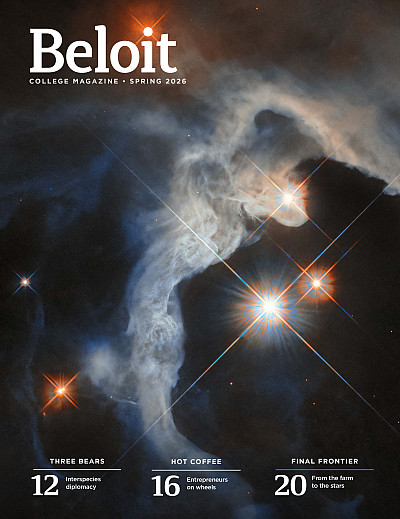
From the Farm to the Stars
Daniel J. Schroeder ’55, a boy from Wisconsin and great-grandchild of German immigrants, played a key role in space exploration while teaching and inspiring generations of students.
While he was a student at Beloit College, Daniel J. Schroeder ’55 met LaVern Hoener ’55, who would become his wife of 70 years. He played quarterback on the football team and led the Buccaneers to their first ever undefeated season in 1952. He graduated with honors, earning a degree in physics with a focus on experimental physics and a minor in math. He was recruited by the Chicago Cardinals, one of the oldest teams in the NFL. They sent him a postcard inviting him to try out, but he decided to go to graduate school instead.
That decision set him on a path that would bring him back to Beloit, where he became a beloved professor of physics and astronomy, a leader among the faculty, and a renowned astronomer who was part of the team that designed and built the Hubble Space Telescope.
An early interest in the stars and mechanical things

Credit: Michael SimonDaniel Schroeder was born in 1933 in Manitowoc, Wisconsin, at his grandmother’s house, the eldest of four siblings. His great-grandparents were German immigrants who came to this country in the 1850s, and he grew up on the small dairy farm they built near Kiel. He embraced his heritage. Bratwurst and sauerkraut were lifelong favorite foods, and Sheepshead (Schafkopf) was a ubiquitous card game at family gatherings.
Dan was often the only student in his class at the one-room elementary school a mile from the farm. He was a bright student, and though he was a great help on the farm — milking cows, harvesting hay, and learning to drive a tractor (backwards) at age three — he knew that farming wasn’t his destiny. Farm life did spark an interest in mechanical things and working with his hands though, starting with a small shop in the farmhouse basement where he built model airplanes.
Recalling his childhood just before the Hubble launch, Dan said,
“I liked to look at the stars, but I never thought of it as a career. It just happened that way.”
After graduating from Beloit College, he earned master’s and doctorate degrees in physics at UW-Madison. Though he took no astronomy courses, he was at UW as it was becoming immersed in the new field of space astronomy. It seemed to him an interesting way to apply physics. He went on to dedicate his life as a scientist to designing, making, and adapting reliable instruments and telescopes for use in space.
An innovator in space science
Throughout his career, Dan was presented with challenges and problems that had never been solved. He was asked to make traditional ground-based instruments work in space — they had to be simple yet efficient, with few or no moving parts. He responded with new ideas and inventions and with a singular focus on getting good data for good science.
From the late 1950s through the 1960s, he worked at UW’s Space Astronomy Laboratory on some of the earliest projects of the newly formed National Aeronautics and Space Administration (NASA), most notably the Orbiting Astronomical Observatory (OAO) program that launched the first true space observatory. He was a pioneer in the field of spectroscopy. His Cassegrain échelle spectrograph was the forerunner of many used on telescopes around the world and in space for the next two decades, including those he designed for the Aerobee rocket program and Kitt Peak’s largest telescope in the early 1970s. At Kitt Peak, he also developed a nonobjective grating spectroscopy technique to search for quasars, another innovation that was widely replicated.

Dan participated in NASA’s early space telescope discussions in the late 1960s and served on the camera design team in the early 1970s. In 1977, he was selected to be one of NASA’s two telescope scientists to oversee the design and fabrication of the Hubble Space Telescope. He worked on the Hubble for over 25 years, including helping to devise a solution for the flaw that caused its initial blurry images. The project presented new and complex dilemmas over the years it took to design and build the telescope. His signature “Wisconsin-style” of space astronomy — simple, efficient, and reliable — helped solve those problems. Expected to have a 20-year lifespan, the Hubble continues on, heading further into space, still doing good science.
Professor, scientist, consultant

Credit: George T. HenryDan Schroeder taught physics and astronomy at Beloit College for 33 years, served as department chair, and retired as professor emeritus in 1996. He delighted many hundreds of students in his Introduction to Astronomy course, one of the most popular classes of his era. He invited students to dinners at his house and held latenight observatory sessions atop Pearsons Hall’s spiral staircase and on the roof of Chamberlin Hall of Science. He was honored as Teacher of the Year three times, and in 1980 was awarded Beloit’s Distinguished Service Citation.
Over the span of his career, Dan served as a consultant on instrument design for many of the world’s leading astronomical facilities, including the Kitt Peak, Lick, Yerkes, and Smithsonian Astrophysical observatories. He participated in the initial discussions about the Webb Telescope. He authored several books, including Astronomical Optics — a graduate textbook — and wrote countless articles for professional journals. During his first sabbatical at Kitt Peak in 1969, Dan and his family enjoyed the adventure of hiking in the Sonoran Desert. After his second sabbatical at Kitt Peak in 1978, he and LaVern decided to retire there. They moved to Arizona in 1996, purchasing an extra lot to ensure a view of Whipple Observatory from their backyard. He was active in the Green Valley Hiking Club for 25 years, until age 88, hiking 3,600 miles and leading 119 hikes. He created terrain navigation maps, served as hike master, and was elected to the club’s hall of fame.
A man of avocations and habits

Credit: Judy Schroeder ’81Carpentry was a lifelong hobby, and Dan was also skilled at plumbing and electrical work. He could fix anything and made himself a workshop in every place he lived. He built rooftop carriers, bunkbeds, and camping kitchens to fit each car for summer family trips. In the 1970s, with the help of family and students, he built a lake cottage in northern Wisconsin, where many of the family’s century-old farm tools are still kept. He built a garage and shed while awaiting the Hubble launch. He built his grandkids a treehouse, where he spent hours with them, building with Tinker Toys and Lincoln Logs and playing board games. At the lake, he built a pier and shared with them his love of nature and the outdoors. He taught them how to canoe, skip rocks, and he set up a telescope to teach them about the moon, planets, and stars.
Throughout his life, Dan’s demeanor and habits never changed much. His mom wanted his hair long for his high school graduation. After that, he got a buzz cut like his dad’s, and wore it that way for the rest of his life. He never wore blue jeans after he left the farm, swapping them for khakis, plaid shirts with pockets, and hush puppies. His shirt pockets held notecards with to-do lists, eyeglasses, a ballpoint pen, and pipe cleaners. His pants pockets carried his pipe, a small measuring tape, and a Swiss army knife. He looked remarkably the same as an emeritus professor as he had as a college graduate.
From the 1960s through the 1980s, he was rarely seen without a pipe in his mouth. He rose at 6 a.m. and started working by 8 a.m. (whether teaching or hammering, much to the chagrin of his students and his kids), and he was asleep by 10 p.m. every night. He would walk into a room and straighten the pictures on the wall. He labeled everything, from nails in Sir Walter Raleigh pipe tobacco cans to each of the thousands of slides he took. His measurements were precise: 1/16” in carpentry, and angstroms or milliarcseconds in space. He did newspaper crossword puzzles, read the comics and sports pages, and monitored weather forecasts. He believed there was a reason for everything, that cleaning was good for the soul, and that mankind’s problems were insignificant compared with the enormity of the universe. His farsighted vision was great for looking at the stars and for spotting four-leaf clovers. He was humble and kind. He never wrote a resume because he never needed one. He never complained. He liked to eat a big bowl of ice cream every night. He always looked up and marveled at what he saw in the night sky.

On Nov. 20, 2025, Daniel J. Schroeder died peacefully at his home in Arizona. He is survived by his wife, LaVern Hoener Schroeder ’55, his son Jim Schroeder ’78, his daughter Judy Schroeder ’81, three grandchildren, two brothers, and a sister.
The Daniel and LaVern Hoener Schroeder ’55 Endowed Scholarship in Physics and The Daniel J. and LaVern Hoener Schroeder Endowed International Program Fund Award were established in 1994. Their generosity has benefitted many students and will continue to do so in the decades to come.