Ben Stucky

Assistant Professor of Mathematics and Computer Science
Co-Department Chair of Mathematics and Computer Science
- Pronouns: he/him/his
- Email: stuckybw@beloit.edu
- Phone: +1 608-363-2193
- Schedule an Appointment
- Office: Room 218, Sanger Center for the Sciences
Description / Biography
Hi there! My favorite part of teaching at Beloit is the close relationships I have with my students. I believe in certain axioms, in particular that everyone deserves to experience the joys of math and computer science, including students from marginalized groups who have been and continue to be excluded from these subjects. Given that some of my students’ future employers can put employees in positions of unknowingly or unwillingly furthering systemic injustices, I believe that part of demilitarizing our subject involves equipping my students with the habits of critical thinking necessary to interrogate the potential uses of the technical skills they acquire in my classroom.
I love to teach all kinds of courses. In intro-level courses like calculus, I get to meet students from many different majors, and we often learn together the ways that mathematics can serve their interests in other disciplines. In more advanced courses like topology, I get to help students deepen their creative problem-solving abilities and logical reasoning, skills which serve them well regardless of their career goals.
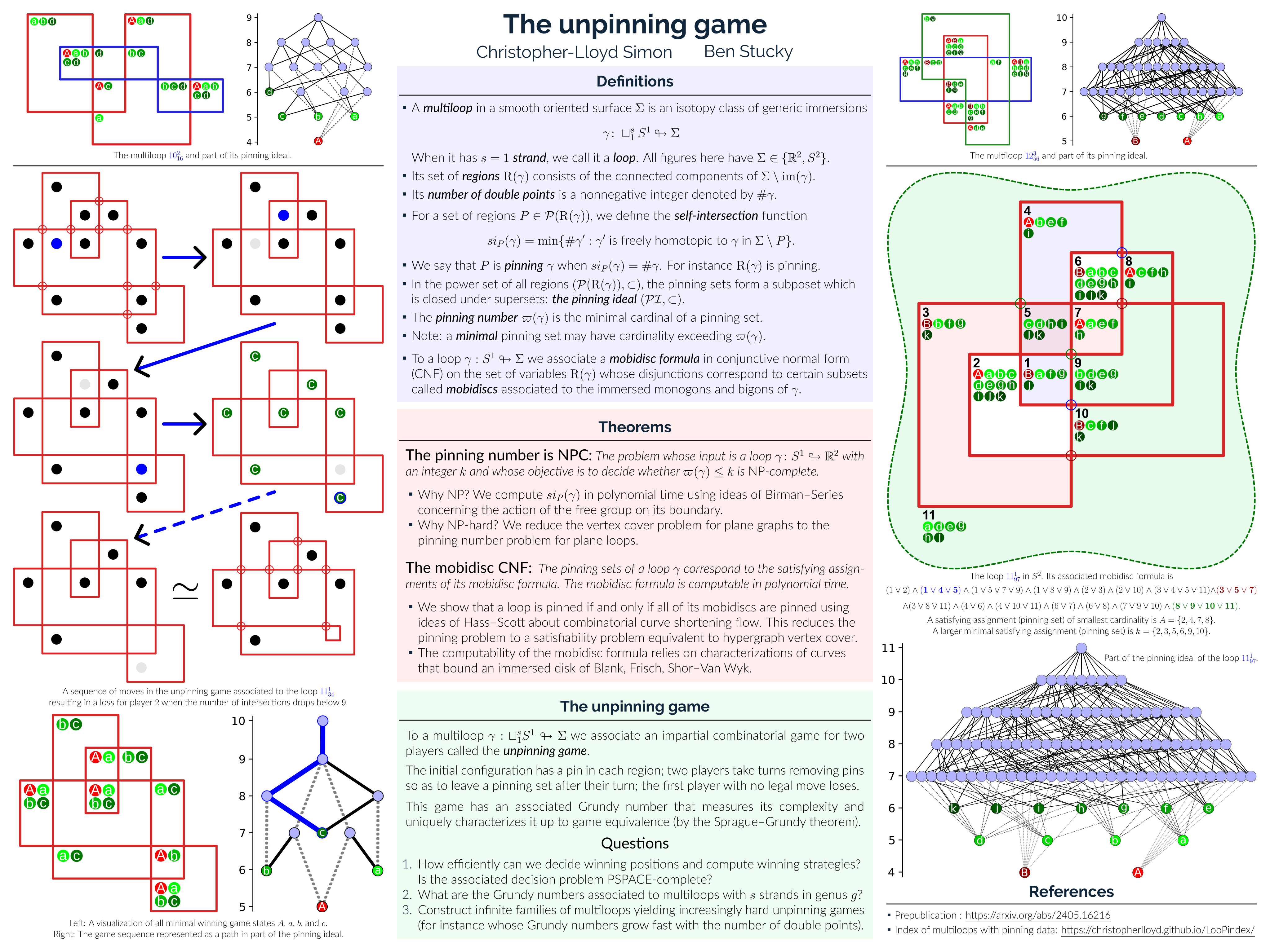
In my research, I am most interested in topics blending theoretical math (especially topology and geometric group theory) and computer science (computability and complexity theory as well as practical algorithms). I am currently thinking a lot about loops, flexible topological objects that you have seen if you have ever charted your path on an exercise routine, or even written the number eight. With Christopher-Lloyd Simon and others (including several math and CS majors at Beloit), we are studying games about pinning loops. Roughly speaking, we want to understand where and how many obstructions (“pins”) are needed to preserve the shape of a given loop, and we are devising, studying, and implementing algorithms to answer this and related questions. There are many unanswered and accessible open questions about pinning loops. Please reach out if you are interested in getting involved!
Outside of work, I enjoy spending time with my family and in my community. I like skateboarding, listening to and making music, and learning about connections between different sciences. I am fascinated by the hacking, reverse engineering, and glitch hunting carried out by communities dedicated to video game speedrunning. I love puzzles and games with a low floor and high ceiling; that is, ones with few and simple rules from which complex logic and deep strategy emerge, and my favorite multiplayer ones also tend to riff on some notion of information asymmetry. Some of them include Baba is You, Hanabi, Poker, Mafia, and the Game of Life (rules here).