Sarah Becan is Sauceome
A portrait of an artist who moved from autobiographical comics to internationally-known illustrated cookbooks, and it happened organically.
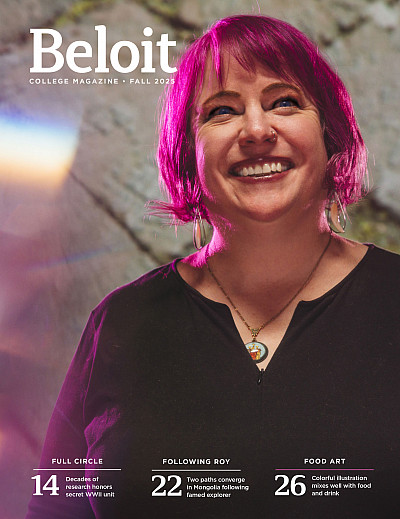
If you were to draw a portrait of illustrator and comic book artist Sarah Becan ’98, you might sketch her seated in her home office in Chicago’s Logan Square neighborhood. She sits at her desk, a drawing table that her parents gave her in high school. On the wall above it are framed illustrations, including some by cartoonist Lynda Barry, 2023 Mackey Chair, given to Becan when she guest-lectured for Barry’s class at the University of Wisconsin-Madison; a letter from illustrator Arnold Lobel in response to Becan’s grade school fan mail; and proofs of her own first two book covers.

At that desk, Becan has created four comic book cookbooks, a graphic novel, a food-based autobiographical web comic, commercial art projects, a bunch of mini comics, and two jigsaw puzzles, including the popular Magic Puzzle Company’s first, “The Happy Isles.”
This spring will see the release of Becan’s latest illustrated cookbook, Let’s Make Cocktails! A Comic Book Cocktail Book (Ten Speed Press, 2026). It’s her fourth in the Let’s Make! series and her first without a coauthor. She wanted to create the beginner cocktail book she wished she’d had in her 20s. “Instead of just being like, ‘I don’t know, people are drinking Midori sours. I guess that’s my drink,’” she says, laughing. The book includes everything from making mojitos to a mocktail template for how and why to muddle.
From Unicorns to Monkeynauts
Becan caught the comic bug early. During a nomadic childhood that bounced her between Texas, Delaware, Texas again, and Missouri, Becan was always drawing. And when she wasn’t filling up notebooks (in seventh grade, her science teacher once scolded her for filling her margins with unicorns), she was reading comics.
It started with the Sunday funny pages and superhero comics, and when she visited her grandparents in Texas, she was enthralled by her grandfather’s volumes of Pogo by Walt Kelly and Crocket Johnson’s Barnaby and Mr. O’Malley . “I would just cloister myself at the bottom of their closet and read through all of these comics,” she says. As she got older in the pre-internet 1980s and 1990s when graphic novels became popular, she read any she came across. “At the time, comic book shops were not a super safe place for a girl, especially.”
In high school, she discovered the edgier strips of alternative newsweeklies by Lynda Barry, Matt Groening, and John Callahan. And when she was at Beloit, her brother gave her Art Spiegelman’s Maus , a light bulb went off.
“It was the first time that I was like, ‘Look at all the things that you can do — I love this medium.’”
At Beloit, Becan was a studio art major; sequential art and comic programs were not yet a thing in college art departments. She wrote a comic for The Round Table , and two art professors — her advisor, the late Ralph Knasinski and Richard Olson — supported her interest, providing resources and inspiration. “I also majored in modern languages [studying French, Spanish, and Russian], because I thought that studio art was not a practical major,” she says. “I’ve done nothing with the languages, but I’ve managed to make a career out of visual art.
After graduation, Becan returned home to St. Louis and started working as a graphic designer, while self-publishing mini-comics like The Monkeynauts (about the history of monkeys sent into space) and The Ouija Interviews (on “conversations” she had with a Ouija board) which she would sell at conventions and comic shops. “I still have a long-arm stapler,” she says. “I’d sit down in front of a Law & Order marathon and staple 300 comic books.” In 2002, she moved to Chicago, where she connected with a community of comic book artists who drew with her and gave her tips on the best comic shops and where to buy cheaper art supplies.
Let’s Make Delicious Art!
In 2010, Becan started creating a daily, autobiographical web comic, I Think You’re Sauceome . “It was an excuse for me to draw every day, and it often ended up being about food,” she says. “It just sort of happened organically.” She wrote about, say, cooking the loads of zucchini in her CSA box and meals she ate out in her neighborhood, and then illustrated her thoughts and experiences in vivid, detailed watercolor comics.

Credit: Sarah Becan ’98
The designer for a local Japanese restaurant, Yusho, saw her work and hired her to illustrate their latest menu items. She would try a new dish, like, say, a madai fish face platter — a whole fish head complete with lips and eyes — and make a one-page comic out of it. Yusho would send the comic out with their email newsletter to encourage customers to explore possibly unfamiliar foods. Becan also illustrated their sake cans and t-shirts.
This led to a gig with Fat Rice, a Macanese restaurant — a mash-up of food from Macau and Portugal — for which she made posters, t-shirts, hot sauce, and beer labels. And when Fat Rice got a new cookbook deal with publisher Ten Speed Press, they brought Sarah along for the ride, including her past work for them and commissioning new art to illustrate recipes.

The most challenging part, she says, was drawing the straight lines of the pasta machine in the section about making noodles. “It’s a lot of symmetrical, mechanical parts,” she says. “My instincts are much more towards color and organic shapes.” Yet she figured it out; Publisher’s Weekly gave it a starred review (“it will thrill ramen aficionados”) and the Chicago Tribune named it one of the best cookbooks of the year.
Following the success of Let’s Make Ramen !, Becan and her coauthor embarked upon Let’s Make Dumplings! A Comic Book Cookbook (Ten Speed Press, 2021).


But when it came to creating recipes, she was a novice. “I had no idea how to fold all the different dumpling shapes,” she says. “And I really wanted to make sure there was a section in [the dumpling book] that was like, ‘This is how you fold this shape and that shape,’ Just really clear, IKEA-level instruction.”
She joined her coauthor in the kitchen to make a ton of dumplings, where she practiced and took videos and pictures. Then came the pandemic, and Becan had plenty of time to make and draw dumplings. The book’s thorough instructions and fun images landed it on many best-of-the-year lists.
Breaking Bread

The idea was to make it a companion workbook to his other books. With Forkish based in Hawaii and Becan in Chicago, the two met over Zoom and he fielded her many baking questions — which was helpful because at this point Becan considered herself “a decent cook and terrible baker.” “Baking takes a lot of different instincts than cooking,” she says. And another challenge was all of that beige.
Becan’s skills grew as a baker and an artist. “In a lot of my work with food, color is the big, integral thing,” she says. “If you’re frying shrimp, it’s one color when it goes into the pan, and it’s a different color when it’s ready to take out of the pan.” But there are no such cues with bread, so she had to focus on subtle texture shifts at each stage of a bake. “How does a blob of dough interact with the surfaces that it’s on or with the hands going into it?” she asked herself as she studied. She still makes a sourdough loaf once a week. And, as a bonus, it’s been a point of connection with her father, who despite his arthritis, has baked every recipe in the book, which has plenty of high hydration breads that require less kneading and so are easier on the hands.
Cocktails and Color
Though Let’s Make Bread! was satisfying, Becan was happy to return to more colorful work. “I mean, the bread was delicious,” she says, “but it was so many shades of brown and beige!” Perhaps that’s why she gravitated toward the idea of her most recent book, Let’s Make Cocktails! A Comic Book Cocktail Book (Ten Speed Press, 2026), one she wrote herself. With the bright hues of liquors and garnishes, differing opacities, and glass shapes, “Coloring this book was a delight,” she says.


With 60 recipes in the book, she invited over friends as tasters. And they didn’t all need to be drinkers. The book has a spirit-free chapter, she writes. “There’s so much about food, about preparing and sharing and consuming a meal, that feels so universal and human and pure and joyful to me in ways that I can’t really express in words. But I sure do like expressing that with classics like the Shirley Temple and Arnold Palmer, as well as a template for a zero-proof buck — a classic drink with a ginger beer base.
Sauceome Times Ahead
With that book finished, Becan is reviving I Think You’re Sauceome , the webcomic she began all those years ago, but now in a newsletter format. “If it weren’t for Sauceome , I wouldn’t be drawing comic book cookbooks today,” she writes in the first issue. The newsletter details her book-writing journey and eating and kitchen adventures, including her determined mission to recreate her Czech grandmother and great-grandmother’s delicious recipe for kolaches, a sweet, filled pastry. “If there is one thing that I know about myself and my place in the world, it’s that I really love drawing food.”
An update to that portrait of the artist: Freshly back from two weeks of teaching teens about comics in Armenia, we see that Becan has cleared her desk for her next project, one she can’t talk much about yet. Sitting at that old white laminate table with its ancient black ink stains, you’ll notice that she’s sketching objects that look remarkably cookie-shaped.
Is that a dot of vermilion jam? A burnished chocolate chip? A lacy topping and a creamy filling? All you can see so far is that they’re not beige and, as usual for her, vibrant, unexpected, and decidedly delectable.