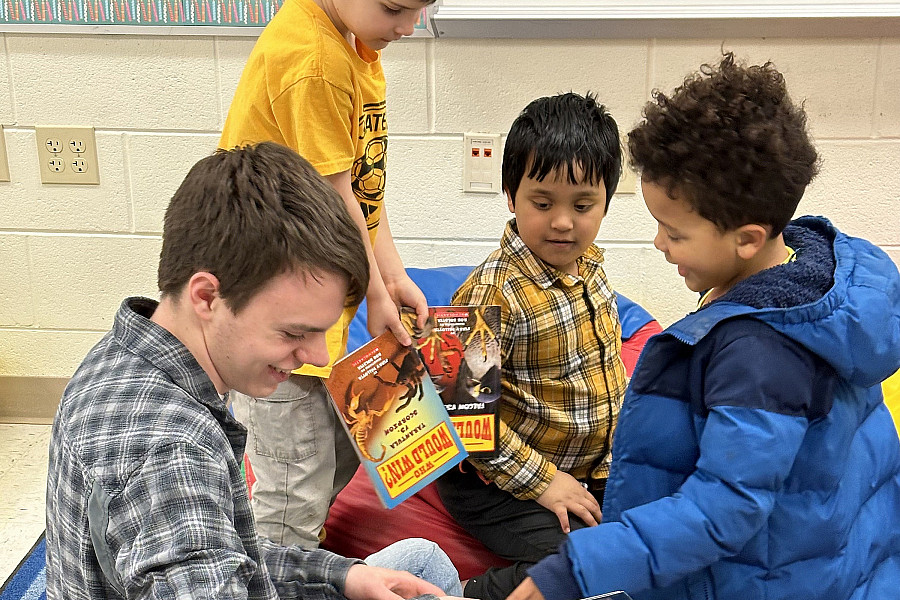
Marcus Studinski ’26 volunteers as a bilingual Reading Buddy at Todd Elementary.
Sociology students help at the Merrill Community Garden as part of their capstone course.
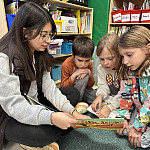
Asher Blumenthal ’29 & Madeline Schnurr ’29 volunteer during Todd Elementary School's after school programming.
Students of Spanish engage with Even Start Family Literacy participants as part of a course on Latinos in the Midwest.
Students, faculty, and community members at the student-curated Le Guin exhibit
Community Connections is a program that offers high-impact learning experiences to Beloit students across disciplines by bringing the college and community together to advance community-based learning, civic engagement, and career readiness. See the list of courses below
In addition to facilitating volunteer opportunities and other community-facing initiatives, Community Connections partners with community stakeholders to develop community-based learning opportunities in the curriculum itself. Get connected withe off-campus community by volunteering or enrolling in one of the Community Connections courses listed below. Check them out!
FALL 2026 Community Connections Courses
Faculty in several departments are offering courses with significant community-based learning components embedded in the course design. Check them out below!
An exploration of major theories and significant research on the development and explanation of social and cultural differences and how they affect the lives and education of youth. The course will investigate student diversity, with special attention to race, class, gender, language, and the inclusion of students with special needs in general education. Issues are examined mainly through the lenses of sociology, anthropology, and education and youth policy. Using the theories and methodologies of these disciplines, students will critically examine how and why race, class, language, ability and disability, and gender have influenced education. (3B) Offered each spring and alternate fall semesters.
This course is a theoretical and practical investigation into interdisciplinary approaches to Social Studies instruction, pedagogy, and content standards. Students become civically-engaged educational problem-solvers who critically examine their roles in local, regional, state, national, and global communities and how that applies to social studies instruction in the classroom. Through studying and applying the individual disciplines of social studies (behavioral sciences, economics, geography, history, and political science), students learn how to support and develop lifelong learners as future teachers who can collaborate and thrive in our interdependent world. Students also learn about applying literacy and other related disciplines to social studies instruction. Students learn about how to address individual differences in social studies content development and ways to support a diverse group of learners. Students explore social studies pedagogies through observation and practice-teaching student placements in various classrooms and engage in various Social Studies activities for approximately 15 hours at a local school. Prerequisites: two 100-level Education and Youth Studies courses. Students should take this course and Education and Youth Studies 265 during the same semester.
Students participate in pre-K to high school classrooms as teaching apprentices, in conjunction with an ongoing workshop devoted to learning about planning, instruction, and assessment. One unit requires a minimum of eight hours weekly in a classroom setting—a total of approximately 120 hours—with the goal of high-quality independent teaching, under the supervision of a cooperating teacher and a college supervisor. All practica take place in local schools that feature significant socio-cultural diversity and offer experience working with a wide range of atypical students in mainstream and special settings. Students are placed in classrooms corresponding to eventual teaching interests, leading in most cases to students teaching. Students aspiring to obtain certification should undertake teaching experiences with children/youth at two different levels of schooling, e.g. high school and middle school. The goal of the workshop will be the completion of a short version of the Educational Teacher Performance Assessment (edTPA), the equivalent to a field-based research project, requiring a written report of approximately 25 pages. Students may take this course twice, with different placements. Offered each semester. $15.00 course fee is for running background check to work in the school district Prerequisite: junior status, and Education and Youth Studies 255, 256 and/or 265 and 266.
Topics in History: Beloit and Beyond: Local and Public History (1). Students in this class work with the Archives and Collections of Beloit College and of the Beloit Historical Society to research topics in the history of Beloit College and the City of Beloit. After learning the best practices and skills for working with rare and often fragile items, students research collection items, the people and places associated with them, and how they contribute to our understanding of wider historical themes. Students develop and design projects to showcase their research, whether in the form of exhibits (physical or virtual), lesson plans, or articles written for websites or newsletters. (Also listed as Museum Studies 295.)
Introduction to Turtle Tunes Music Outreach Program (.5). This course is a one-time course required prior to teaching music to small groups of third graders at nearby Todd Elementary School. In this introductory course, students work with Turtle Tunes directors for one month prior to teaching at Todd Elementary. Instruments taught include violin, cello, guitar, and percussion (and others depending on availability). Students learn about the philosophy and psychology of teaching, how to co-teach and work within an organization, and develop their own lesson plans and classroom management protocols based on established practices and an understanding of their own personality, strengths and weaknesses. After one month of training, students teach two days a week for an hour after school at Todd Elementary. Scheduling is flexible.
In this course, students deepen their understanding and role in the community by working with local organizations and businesses that serve the city of Beloit. Students will also learn about different approaches to community development and social change by examining strengths and assets of non-profit, for-profit, government, and grassroots institutions. This is a community-based learning course, integrating fieldwork and reflection. Each student is assigned a placement with a community partner where they are supervised by experienced community leaders and assist in supporting the mission of the institution. Students spend approximately seven hours a week (90 hours a semester) at their placement. Students reflect on their experiences at their site placements and the role of individuals and institutions in communities through supporting readings, materials, and activities used during weekly class periods. Applications can be found at https://forms.gle/gjCWkBvD7ygpUFAaA. Prerequisite: Sophomore standing or above. Students must apply and provide references to be admitted into this course.
Impact Beloit Community Fellowship I (1). The Impact Beloit Community Fellowship provides advanced students opportunities to have sustained engagement with a community partner organization, completing project-based work driven by the organization’s needs. Each student spends approximately eight to 10 hours a week working with a community partner, mostly non-profits. In addition, all Fellows attend weekly meetings with their Fellows cohort and/or mentor to set and assess goals, engage in professional development workshops, discuss experiences at their respective sites, and learn about the social impact of civic engagement. Writing assignments, such as written reflections on the work experience, are required. Students must apply, provide references, and be interviewed by an Impact Beloit faculty or staff member. If they pass the screening process, they then interview with the community partners that Impact Beloit instructors identify could be a good match. Preference is given to seniors who have previous community-based experience. Prerequisite: junior or senior standing.
In the Impact Beloit Concierge Internship Program, students develop and apply professional and transferable skills through project-based internships with employers, most in the Stateline area, preparing them for life after Beloit. Students work at least 10 hours per week in roles such as finance, marketing, communications, event management, sales, and more. Interns engage in meaningful work that has a tangible impact on the organization, the Stateline community, and their own career development. Students also participate in a weekly class that emphasizes reflection, problem-solving, navigating professional settings, and community-based learning through readings, discussions, and written work. Students must apply, provide references, and be interviewed by an Impact Beloit faculty or staff member. If they pass the screening process, they then interview with the organization that Impact Beloit instructors identify as a good match. Preference is given to seniors with prior experience. Prerequisite: junior or senior standing.
Life-Span Developmental Psychology (1). This course examines the physical, social, and cognitive changes that occur between conception and older adulthood. A wide range of issues will be addressed, such as the contributions of genetics and the environment, gender differences, family and interpersonal relations, career development, retirement, and death. Includes at least 15 hours of field experience. (3B) Offered each year. Prerequisite: Psychology 100.
Through hands-on engagement and academic reflection, this course provides students with the opportunity to further develop and apply their psychological knowledge in an area of personal and community interest. With the help of the instructor and community partners, students will complete a project or internship involving approximately six hours a week (approximately 70 hours over the course of the semester) working with and/or at an assigned field site in the local community. In addition, class meetings will focus on the development of professional skills and career planning, as well as discussion of the opportunities and challenges of putting psychology into practice. (CP) Offered most years. Prerequisite: Psychology 162 and senior standing; approval of department.
This course focuses on the application of sociological theories, paradigms, and methods in examining social processes. Students focus on particular institutions to examine some aspect of institutional structure, culture, or interactions. The goal is to identify patterns in social processes within institutions and to utilize sociological theories, paradigms, and methods to make sense of these patterns. The course also focuses on the structure of the sociology major, a liberal arts education, and post-college pathways. May be repeated for credit if topic is different. (CP) Offered each year. Prerequisite: Sociology 100 or 150, 200, 205, and 211.
Students study advanced grammatical structures and vocabulary to expand and strengthen their lexical and grammatical understanding of the language while completing writing assignments that explore health topics in the Spanish-speaking world and how culture impacts health. While engaging with the writing process, students also have the opportunity to build their confidence in listening, reading, speaking, and conducting research. Participation in Spanish-language activities outside the classroom and/or in the local Latino community is expected. (1S) (Also listed as Health and Society 218.) Offered each semester. Prerequisite: Spanish 210, 214, or equivalent.
NEED WHEELS? If you are volunteering or interning in Beloit, Janesville, or Rockford during the fall, spring, or summer as part of a Community Connections course and need transportation, we have a Community Connections car available for use. For more information, please refer to the College Vehicles site.
PRESENT ON YOUR EXPERIENCES. Students in these course may have an opportunity to present on their experiences at the Beloit & Beyond Conference, held annually during the first week of November.
Recent stories
Promoting literacy for life
A sociology major with English and philosophy minors from Orlando, Florida, Olivia Alvarado ’25 is making a difference as an Impact Beloit Community Fellow with the Stateline Community Foundation’s Literacy for Life Program.
Eight students of all majors had the exciting opportunity to connect with members of Beloit’s LGBTQ+ community and help to preserve Beloit’s queer history through a series of interviews, document analysis, and archive development.
In Prof. Sylvia Lopez’s Intro to Latinx Studies (SPAN 270), a Community Connections course, students have the opportunity to volunteer with local organizations to connect with Beloit’s Latinx and Spanish-speaking members.
Are you a member of the Beloit community with questions about other Community Connections opportunities? Contact Impact Beloit staff to explore the possibilities.